How We Manage Audio Across More Than 50 Hotels from a Single Dashboard
One dashboard, a fleet of Raspberry Pi devices spread across dozens of hotels, and full zone-by-zone control. This is what real-world RoomStream operations look like at scale.
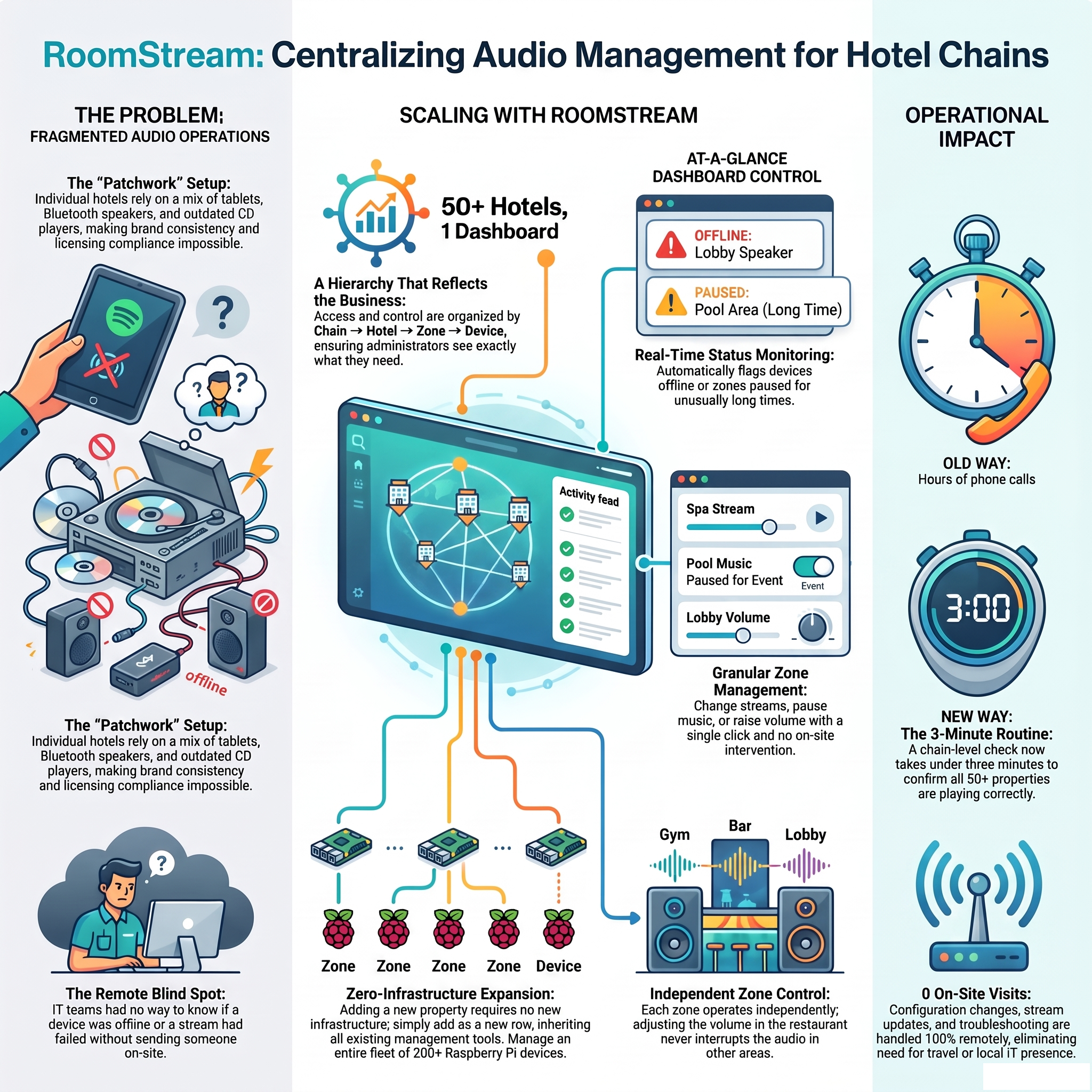
Managing ambient music in a single hotel is straightforward. Managing it across more than 50 properties spread across multiple cities — with IT teams that are rarely on-site — is a different problem entirely. Each hotel has several zones (lobby, bar, pool, gym, spa), each zone needs its own stream, and someone has to be able to change it, pause it, or verify it is still playing without getting in a car and driving there.
RoomStream was built to solve exactly that: a single dashboard where a hotel group sees and controls audio playback across all its properties, without each hotel needing its own isolated system.
The Real Problem at Scale
Before centralised audio management, the typical setup at a multi-property group involved a patchwork of solutions: a tablet running a Spotify playlist in reception, a separate Bluetooth speaker in the bar managed by whoever was on shift, a CD player in the spa that nobody had touched since 2019. Consistency was impossible. Compliance with licensing requirements was a guessing game.
The IT team would receive calls from individual hotels whenever audio stopped working, with no remote visibility into what had gone wrong. Was the device offline? Had the stream URL changed? Was it a network issue at that property? The only way to find out was to ask the person on the ground to look at something they usually had no context to interpret.
Scale that to 50 hotels and the situation becomes untenable. RoomStream replaces this with a structured hierarchy that mirrors the actual business.
A Hierarchy That Reflects the Business
The dashboard is organised the same way the hotel group is: chain → hotel → zone → device. A chain administrator sees all their properties; a hotel administrator sees only their own; a superadministrator sees every chain on the platform. Each level inherits its appropriate permissions without any manual per-hotel configuration.
This is not just a convenience. With more than 50 active hotels, the alternative — a separate instance per property — would be unmanageable to maintain and impossible to audit. A chain-level view means a compliance check (are all devices online? are all zones playing the correct stream?) takes seconds, not an hour of hotel-by-hotel phone calls.
What You See at a Glance
From the chain-level overview, an administrator can see in seconds:
- How many devices are online right now.
- How many zones are playing music and how many are paused.
- Whether any stream has stopped responding.
- Which devices are still unassigned to a zone.
There is no need to drill into each hotel to know if something is wrong: the dashboard flags issues automatically. A device that has been offline for more than a few minutes is highlighted. A zone that has been paused for an unusually long time stands out. The system draws attention to what needs attention, and the rest stays out of the way.
Zone-Level Control Without On-Site Access
Changing the stream in the spa of a hotel in another city, pausing the pool area during a private event, or raising the lobby volume for a busy Saturday afternoon — all of these happen from the dashboard with a single click, with the change taking effect in seconds. No phone call to the hotel, no asking someone on the ground to unplug a device and plug it back in.
Each zone also has its own volume control, independent of the others. Turning up the restaurant does not affect the lobby. Pausing the gym does not interrupt the bar. Control is at exactly the granularity the operation requires.
Scaling Without Losing Control
RoomStream's multi-tenant design is not a feature added later: it is the foundation the system was built on from day one. Adding a new hotel to the chain requires no infrastructure changes — it is one more row in a table, with its own zones and devices, already isolated from the rest of the chain by design.
That is the difference between a system that works well with 3 hotels and one that continues to work well with 50. The architecture does not degrade as the fleet grows; if anything, it becomes more useful, because the chain-level visibility means problems at any property surface immediately rather than being discovered hours later by a guest complaint.
A Practical Example
A chain IT manager running audio for 52 hotels uses RoomStream's morning dashboard check as a two-minute routine: open the chain view, confirm all devices are green, spot the two that flagged offline overnight (one was a network restart at the property, already recovered; one needs a manual restart, handled remotely in 30 seconds). Total time: under three minutes. Under the old system, this would have required emails or calls to each property and would often be skipped entirely, meaning problems only surfaced when a guest complained.
Ready to centralise your hotel group's audio management?
RoomStream gives chain IT teams full visibility and control over every zone in every property from a single dashboard.
Learn more about RoomStream →