One Zone, One Hotel, One Chain: Why RoomStream Was Built for Hotel Groups from Day One
RoomStream is not a music player with shared accounts bolted on. It is a system with genuine data isolation between chains, hotels and zones — designed that way from the database up, not retrofitted on top of a single-venue product.
Most audio management systems for hospitality started as products built for a single venue. A restaurant installs it, it works well, the company grows and wants to use it in multiple locations. So the product adds "multiple accounts" or "multi-location support" — which in practice usually means a permission layer built on top of a data model that was never designed for it.
The result is subtle but real: an administrator who can accidentally see data from the wrong property, a device that can be moved between chains without proper authorisation, audit trails that mix events from different customers. These are not catastrophic failures, but they accumulate into an unreliable foundation — especially when the platform is managing infrastructure across properties that belong to different legal entities or different brands within the same group.
RoomStream was designed the other way around.
The Hierarchy Is the Foundation
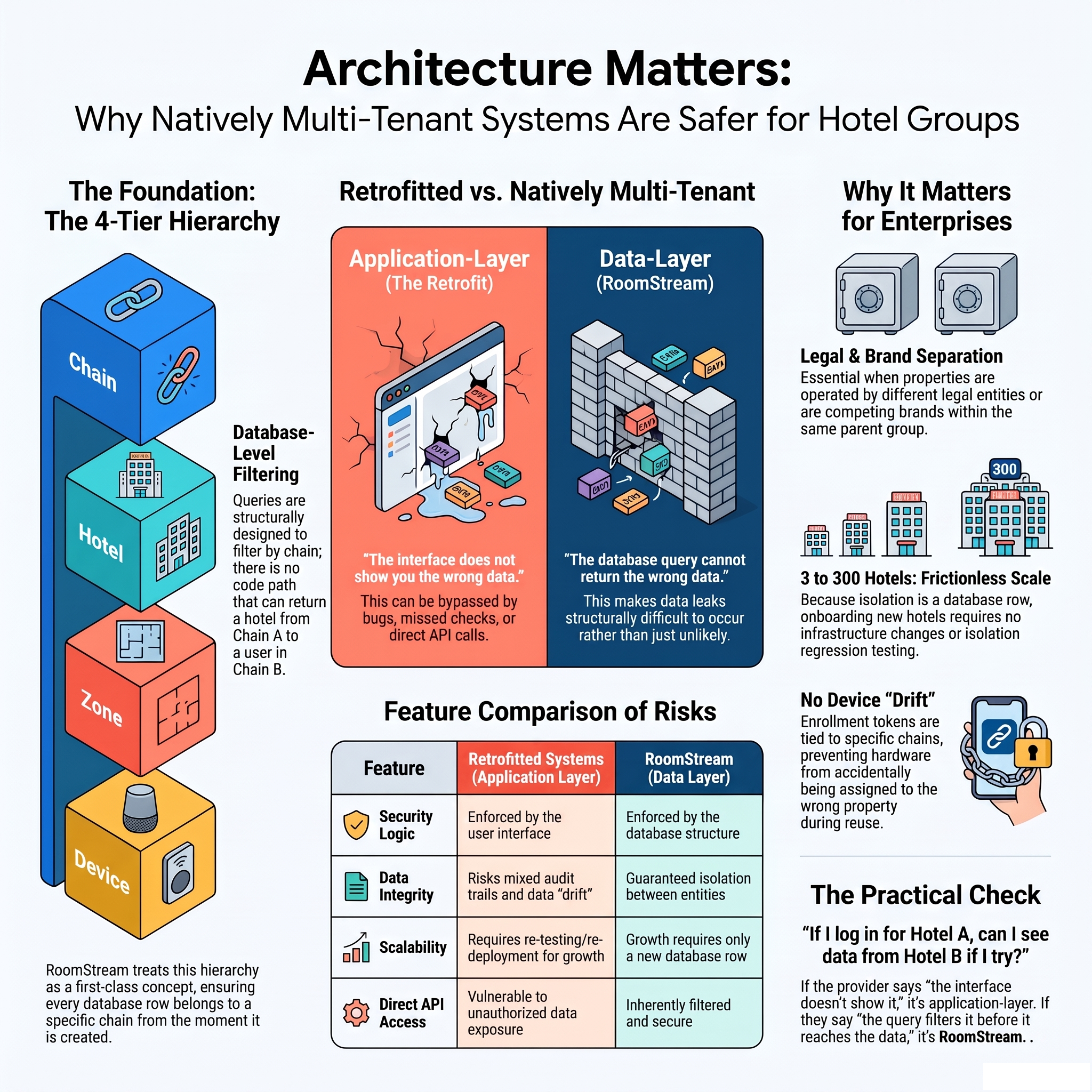
The data model that RoomStream is built on treats the hierarchy chain → hotel → zone → device as a first-class concept, not an afterthought. Every row in the database belongs to a chain. Every query that retrieves data filters by chain. There is no code path that can return a hotel belonging to chain A when the requesting user belongs to chain B — not because the interface prevents it, but because the database query structurally cannot produce that result.
This is the distinction between a permission system enforced in the application layer and one enforced in the data layer. Application-layer enforcement can be bypassed by a bug, a missed check, or a direct API call that skips the normal code path. Data-layer enforcement cannot: the query either includes the chain filter or it returns nothing useful.
What This Means in Practice
- A chain administrator cannot see, even by accident, the hotels of a different chain — not because the interface hides them, but because they are not in the results of any query they can issue.
- A hotel administrator sees only their own property, regardless of how many hotels the chain has.
- Each device enrolment token belongs to a specific chain. A device cannot "drift" into the wrong chain through hardware reuse, even if someone reuses the same Raspberry Pi.
- Stream configurations, network templates, and zone assignments are all scoped to their chain. Changing a stream in one chain cannot affect another chain.
Why This Matters More Than It Seems
When a platform manages the infrastructure of multiple different clients — or multiple brands within the same group — an isolation failure is not a minor bug. It is a data leak. Seeing another client's hotel names, zone configurations, or stream URLs is information that should be private. Designing isolation at the data level rather than the interface level is what makes that leak structurally difficult to occur, not just unlikely.
This becomes especially relevant in enterprise contexts where different properties in the same group may be operated by different legal entities, where audit requirements apply, or where the platform is shared across brands that are direct competitors in the same market.
Application-layer isolation means: "the interface does not show you the wrong chain's data." A bug in the interface, or a direct API call, can break this.
Data-layer isolation means: "the database query cannot return the wrong chain's data." There is no code path to exploit.
Growing Without Friction
The practical consequence of this design is that adding a new hotel to a chain, or onboarding a new chain to the platform, requires no infrastructure changes. It is one new row in a table, with the same isolation guarantees as all the others. The system does not need to be reconfigured, redeployed, or tested against isolation regressions every time the fleet grows.
This is the difference between a system that was designed for one hotel and "also works" for several, and one designed for several from the start. The first kind works well at small scale and develops subtle problems as it grows. The second works the same way whether you have 3 hotels or 300.
A Practical Check
If you are evaluating audio management platforms for a multi-property group, a useful question to ask is: "If I log in as an administrator for Hotel A, can I see any data from Hotel B — even if I try?" If the answer involves phrases like "you would not normally see that" or "the interface does not show it," that is an application-layer answer. If the answer is "no, because the query filters by your hotel before it reaches the data," that is a data-layer answer. The second one is the one you want.
Built for hotel groups, not retrofitted for them
RoomStream's multi-tenant architecture gives every chain, hotel and zone genuine data isolation — designed in from day one.
Learn more about RoomStream →