The Self-Healing Raspberry Pi: Inside RoomStream's Reliability Architecture
A Raspberry Pi in a hotel has nobody watching it. That is why RoomStream is designed to recover from almost any failure on its own — without a technician, without a phone call, without music stopping for days.
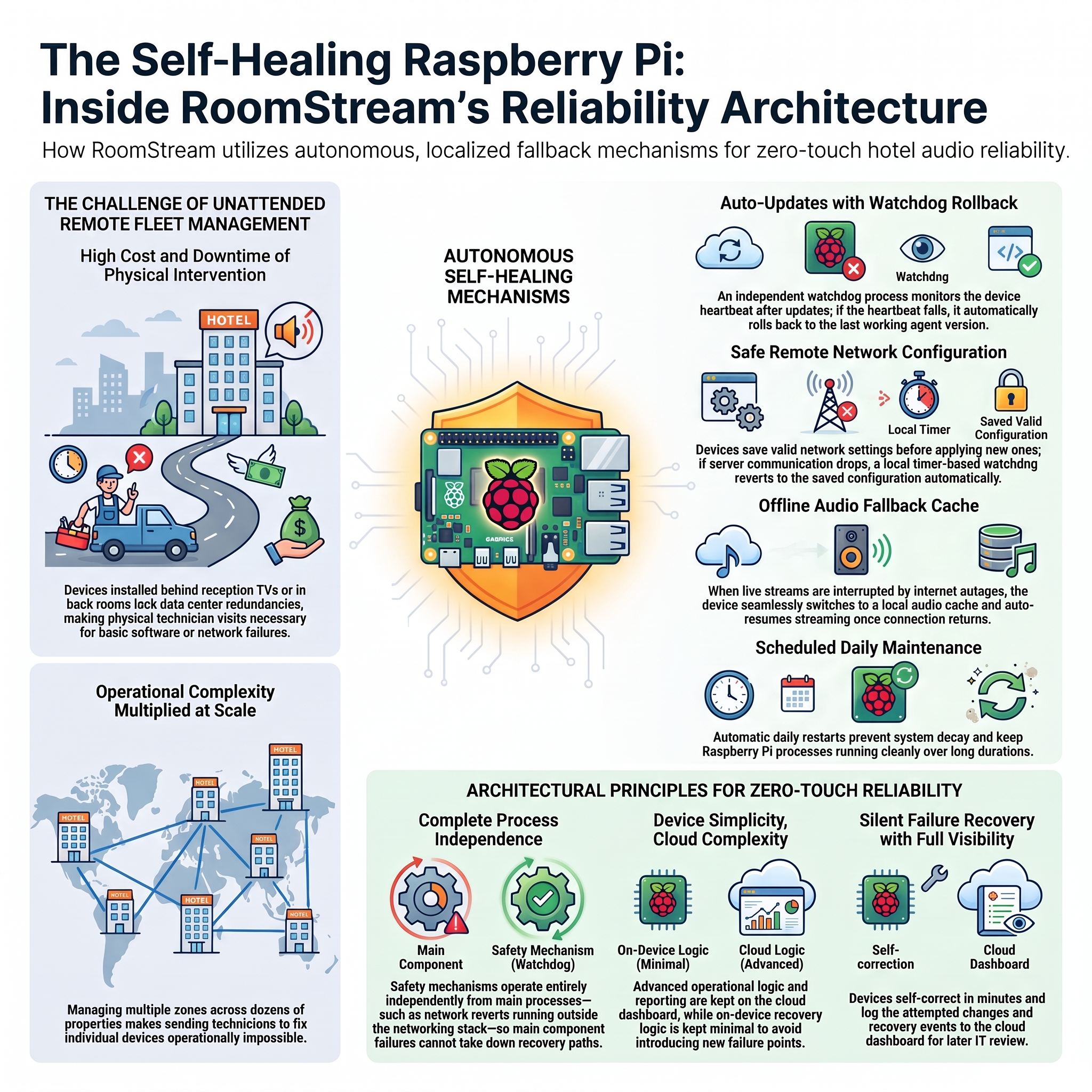
When you deploy a Raspberry Pi in a hotel lobby and walk away, you are making a bet: that the device will keep running reliably for weeks or months without anyone touching it. If something goes wrong — a bad software update, a network change that cuts off connectivity, an internet outage — the fallback cannot be "send someone to look at it." That costs time, money, and in practice means music is down for days before anything gets fixed.
RoomStream is built on the assumption that these failures will happen, and every component is designed to recover without human intervention. Here is how that works in practice.
The Problem With Unattended Devices
A Raspberry Pi connected to a speaker in a hotel reception is not a server in a data centre with monitoring, redundant power, and an on-call engineer. It is a small computer in a back room, possibly behind a TV, with no one watching it. If the agent controlling it updates badly, if a network change makes it unreachable, or if it loses its internet connection for hours, the traditional answer is "go fix it physically."
At small scale, this is inconvenient. At the scale of 50 hotels with 4–6 zones each, it is operationally impossible. A system designed for this environment has to assume failures will happen and build recovery into every layer.
Self-Update With a Safety Net
Each device periodically checks whether a new version of the agent is available and updates itself automatically. But remotely updating software without supervision is risky: if the new version has a bug, the device could be stuck without music indefinitely, and there is no easy way to fix it from the outside.
This is why there is an independent watchdog process: a separate lightweight process that monitors whether the device is still "alive" (sending its periodic heartbeat to the server) after an update. If the heartbeat is missing for longer than a defined margin, the watchdog automatically rolls back to the previous version that was working. The device never gets permanently stuck on a broken update.
The rollback is fully automatic. No alert, no manual intervention — the device notices the problem itself, fixes itself, and reports back to the dashboard as recovered. From the administrator's perspective, the update simply did not apply, and the activity log shows exactly why.
Network Changes: The Same Principle
Changing the network configuration of a remote device is the most dangerous operation that exists: if the new IP address or gateway is wrong, the device becomes unreachable and there is no way to fix it via software. The only solution would be physical access — which, at a hotel 200 km away, is an expensive problem.
RoomStream applies exactly the same philosophy here. Before applying a network change, the device saves the configuration that was already working. If the device cannot re-establish communication with the server within a reasonable window after the change, a local watchdog reverts the network to the previous configuration — entirely on its own, without needing to receive an instruction from the server (which it cannot, because the network is broken).
This makes remote network configuration genuinely safe: if you enter the wrong IP, the device corrects itself. The dashboard will show the attempted change and the automatic revert, so the administrator knows exactly what happened and can try again with the right settings.
Playback That Survives an Internet Outage
If a hotel loses its internet connection, music should not stop abruptly. Each device maintains a local fallback audio cache, and when it detects that the live stream is not responding, it switches automatically to local playback until the connection is restored.
The transition is seamless from the perspective of anyone in the hotel. The dashboard shows the device as playing from cache, so the IT team knows there is a connectivity issue at that property without needing anyone to call in. When the connection comes back, the device switches back to the live stream automatically.
Why This Is Hard to Get Right
The challenge with self-healing systems is that the fallback mechanism itself can fail. A watchdog that crashes, a rollback that introduces a different bug, a cache that runs out of space — each recovery path has its own failure modes. The design discipline is to keep each safety mechanism as simple as possible and as independent as possible from the component it is watching, so that a failure in the main system does not also take down its own recovery path.
In practice this means the watchdog is a minimal process with no shared state with the main agent, the network revert is triggered by a timer running outside the networking stack, and the cache logic is decoupled from the stream player. Complexity is kept in the dashboard, not in the device, where it is easier to update and impossible to break permanently.
The Result
None of these mechanisms are visible from the dashboard in normal operation — and that is precisely the point. The reliability of a system at this scale is not measured by how well it works when everything goes right, but by how little you notice when something goes wrong.
A device that would previously have required a same-day site visit now recovers in minutes and flags the event in its activity log for later review. A hotel that would have had no music all day has seamless playback throughout. The IT team sees a resolved issue instead of an unresolved one.
Fleet reliability at scale, without on-site visits
RoomStream's self-healing architecture keeps your hotel audio running — even when things go wrong.
Learn more about RoomStream →